
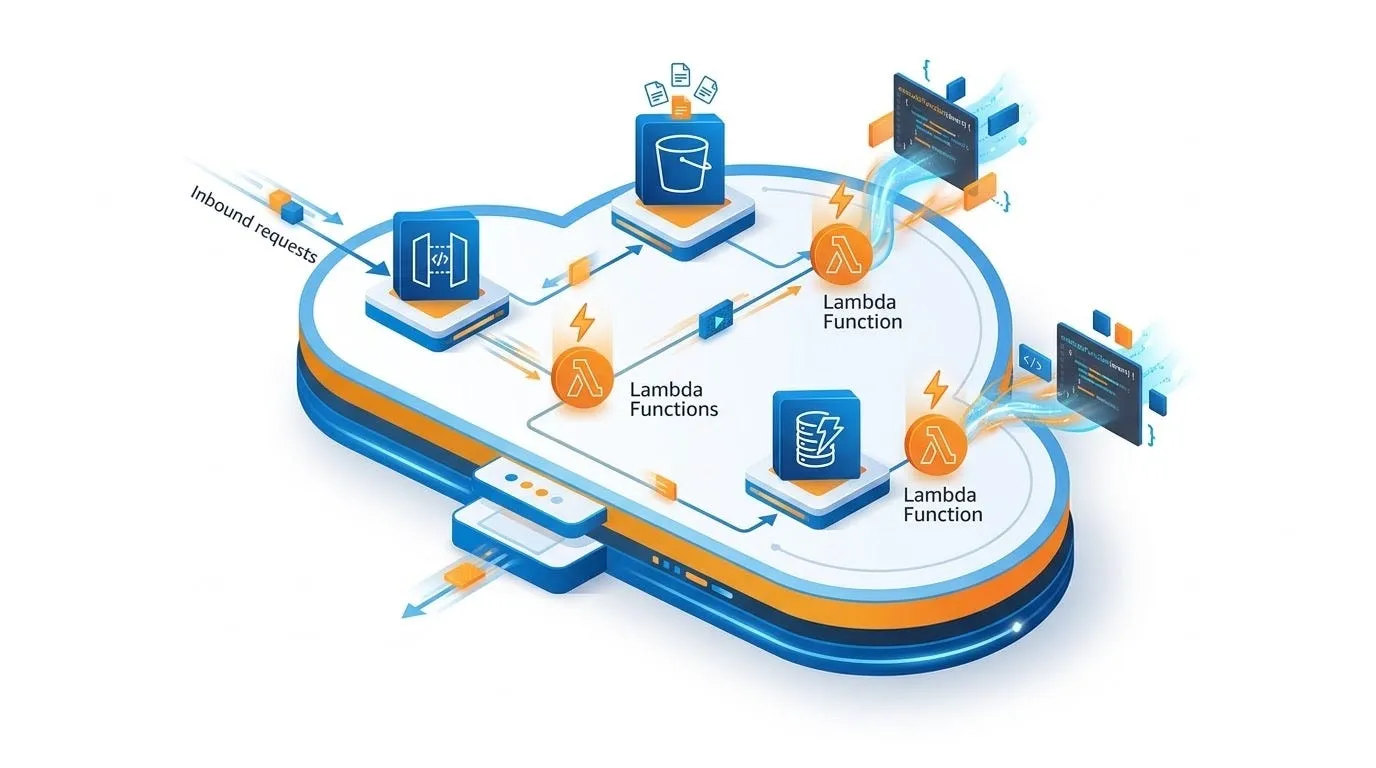
Getting Started with AWS Lambda: Building Your First Serverless Application
Introduction AWS Lambda has fundamentally changed how developers build and deploy applications. By eliminating the need to manage servers entirely,…
Development Alex Jordan 2 min read

Infrastructure as Code (IaC) is a foundational DevOps practice that treats cloud infrastructure the same way developers treat application code — defining it in declarative files, storing it in version control, and deploying it through automated pipelines. On Microsoft Azure, two tools dominate the IaC landscape: Azure Bicep and HashiCorp Terraform. This blog compares both tools to help you choose the right approach for your organization.
Azure Bicep is Microsoft’s native IaC language for Azure, designed as a simpler, more readable alternative to ARM templates. Bicep is Azure-specific — it can only deploy Azure resources — which means it has first-class support for every Azure service the moment it launches. Bicep files are concise, readable, and compile to ARM templates under the hood, giving you full Azure Resource Manager capabilities without the verbosity of raw JSON.
Terraform is a cloud-agnostic IaC tool developed by HashiCorp that supports Azure, AWS, GCP, and hundreds of other providers through a plugin architecture. Terraform uses its own declarative language called HCL (HashiCorp Configuration Language). Its multi-cloud support makes it attractive for organizations managing infrastructure across multiple cloud providers. Terraform has a large community, extensive module library, and mature tooling ecosystem.
Choose Bicep when your organization is Azure-only, wants the simplest possible Azure IaC experience, and benefits from Microsoft’s native tooling and documentation. Bicep integrates deeply with Azure DevOps and GitHub Actions, and Microsoft continuously improves it to support new Azure features immediately at launch.
Choose Terraform when your organization manages infrastructure across multiple cloud providers and wants a consistent tool and workflow across all of them. Terraform’s module ecosystem provides reusable building blocks for common patterns, and its large community produces abundant learning resources. Ozy Solutions has deep expertise in both Bicep and Terraform and can help you choose and implement the right tool for your context.
Both Bicep and Terraform are excellent choices for Azure IaC. The right choice depends on your multi-cloud strategy, team skills, and organizational context. Ozy Solutions’ Azure DevOps team can help you adopt IaC practices with either tool. Contact us to get started.
Learn more about our Azure DevOps Solutions services or visit Ozy Solutions to get started today.

Keep Reading
Introduction AWS Lambda has fundamentally changed how developers build and deploy applications. By eliminating the need to manage servers entirely,…
Introduction As serverless applications grow more sophisticated, the need for coordinating multiple Lambda functions and services in complex workflows becomes…
Introduction Two of the most important technology choices in modern cloud application development are serverless functions (AWS Lambda) and containers…
Let’s Talk
Partner with a creative tech team to design, develop, and launch software solutions built to scale your business on time and on budget.
Novaryn LLC, 1331 Merl Place
Longmont, CO 80501