




Azure App Service vs Azure Functions vs AKS: Choosing the Right Compute
Introduction One of the most common questions Azure developers face is choosing the right compute service for their application. Azure…
 Skip to content
Development Alex Jordan 3 min read
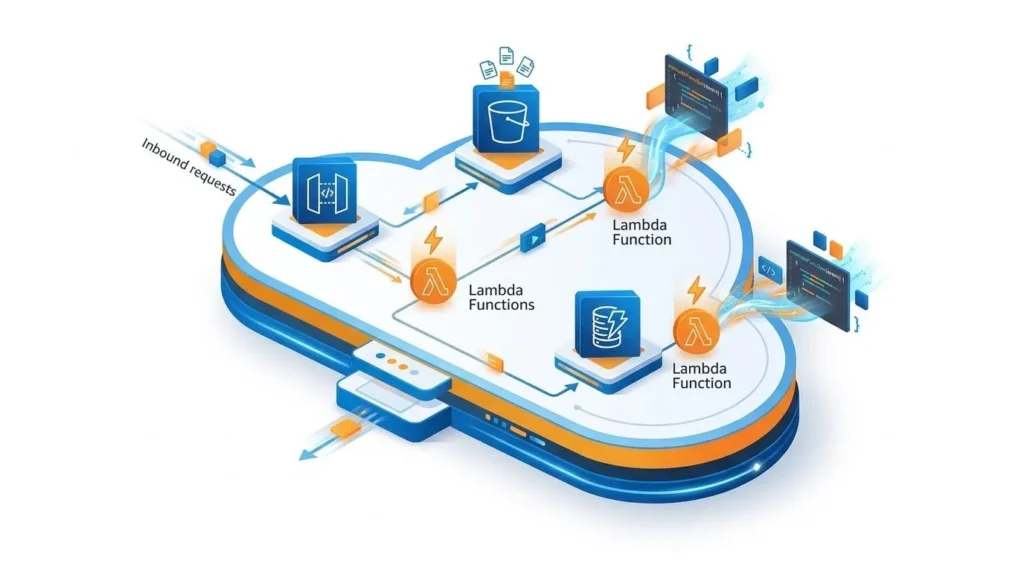
AWS Lambda has fundamentally changed how developers build and deploy applications. By eliminating the need to manage servers entirely, Lambda lets you focus purely on writing business logic while AWS handles all the infrastructure concerns. This tutorial walks you through building your first serverless application on AWS Lambda.
AWS Lambda is a serverless compute service that runs your code in response to events and automatically manages the compute resources required to execute that code. You upload your code, define the event sources that should trigger it, and Lambda takes care of everything else.
Lambda supports multiple programming languages including Python, Node.js, Java, Go, Ruby, .NET, and custom runtimes. Functions can run for up to 15 minutes, use up to 10 GB of memory, and scale automatically to handle any volume of requests.
Function: The unit of Lambda deployment. A function contains your code plus configuration specifying the runtime, memory, timeout, and execution role.
Event Source: The trigger that invokes your function. Common event sources include API Gateway (HTTP requests), S3 (file uploads), DynamoDB Streams (database changes), SQS (queue messages), and EventBridge (scheduled or custom events).
Execution Role: An IAM role that Lambda assumes when executing your function. It defines what AWS resources your function can access.
The most common Lambda pattern is building REST APIs. Create a Lambda function that accepts an event containing HTTP request details and returns a response object with a status code, headers, and body.
Configure API Gateway to route HTTP requests to your Lambda function. API Gateway handles SSL termination, request routing, authentication, throttling, and caching. Your Lambda function just needs to handle the business logic.
Ozy Solutions’ AWS serverless solutions team can help design and implement production-grade serverless APIs. Visit our blog for hands-on Lambda tutorials.
Lambda has built-in retry behavior for asynchronous invocations — if your function fails, Lambda retries it twice before either discarding the event or sending it to a dead-letter queue.
For synchronous invocations (like API Gateway), the caller receives the error immediately and is responsible for retry logic. Design your functions to be idempotent where possible so that retries do not cause unintended side effects.
Lambda automatically sends metrics to CloudWatch including invocation count, duration, error rate, and throttle count. Use CloudWatch dashboards to monitor your functions’ health.
Enable X-Ray tracing to get distributed traces that show how your function performs and where time is spent. Lambda Powertools is an excellent library that adds structured logging, metrics, and tracing to your functions with minimal code.
AWS Lambda makes it remarkably easy to build scalable, cost-effective applications without managing infrastructure. Once you experience serverless development, going back to managing servers feels like a step backward. Ozy Solutions’ AWS serverless solutions expertise can accelerate your serverless journey significantly.

Keep Reading
Introduction One of the most common questions Azure developers face is choosing the right compute service for their application. Azure…
Introduction Containers have transformed how applications are built and deployed, and Kubernetes has emerged as the standard for orchestrating containerized…
Introduction Cloud-native development is the practice of building applications that are designed specifically to take advantage of cloud computing capabilities.…
Let’s Talk
Partner with a creative tech team to design, develop, and launch software solutions built to scale your business on time and on budget.
Novaryn LLC, 1331 Merl Place
Longmont, CO 80501

